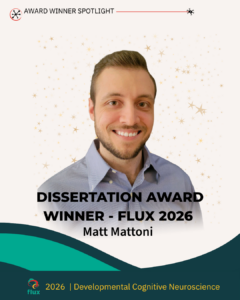
 The Flux Society is pleased to recognize Matt Mattoni as the recipient of the Flux Society 2026 Dissertation Award.
Matt will receive his Ph.D. in Clinical Psychology from Temple University in August 2026 before beginning a T32 postdoctoral fellowship in adolescent mental health at Northwestern University. His research applies precision neuroscience methods to understand how individual differences in brain networks relate to psychopathology and behavioral development. In his dissertation work, Matt demonstrated that group-averaged functional connectivity networks fail to accurately represent individual adolescents in the ABCD study—a finding with significant implications for predicting behavioral outcomes from brain imaging data. He published the central findings from his dissertation as a Registered Report in Imaging Neuroscience, underscoring his dedication to rigorous, transparent science. Beyond his research, Matt actively contributes to science communication as host of the Flux Sensitive Periods podcast through the Flux Communications Committee. Looking ahead, he aspires to establish a precision clinical neuroimaging laboratory focused on translating brain research into improved mental healthcare and public health outcomes.
The Dissertation Award recognizes exceptional doctoral research that advances our understanding of developmental cognitive neuroscience. In this spotlight, Matt reflects on the motivations behind his work, surprising findings from his dissertation, the Flux community's influence on his career, and the future directions he envisions for the field.
From Clinical Translation Gaps to Precision Neuroimaging
For Matt, the journey into precision neuroimaging began with a fundamental question about clinical impact. His concern about the limited ability of neuroimaging findings to translate into meaningful clinical applications shaped the core questions of his dissertation research.
When asked "What inspired you to pursue this area of research?" Matt says:
"I was really excited about my dissertation as the culmination of my doctoral research uniting clinical psychology, idiographic science, and DCN. My interests stem from the limited clinical translation of neuroimaging findings. Mainly, concern that our reliance on cross-sectional group averages has modest ability to (1) accurately predict clinical phenotypes across heterogeneous individuals, and (2) inform within-person inferences, such as mechanisms of psychopathology. As a foundation to my dissertation, I detailed these issues in an applied review of idiographic science to cognitive neuroscience.1 While heterogeneity had become a hot topic in the field a, I felt commentary from myself and others about its consequences still needed empirical support. My dissertation quantified just how different functional connectivity networks are across adolescents, and how this heterogeneity limits individual-level prediction.2"
1Mattoni, M., Fisher, A. J., Gates, K. M., Chein, J., & Olino, T. M. (2025). Group-to-individual generalizability and individual-level inferences in cognitive neuroscience. Neuroscience and biobehavioral reviews, 169, 106024. https://doi.org/10.1016/j.neubiorev.2025.106024
2Mattoni, M., Smith, D. V., Chein, J., & Olino, T. M. (2025). Functional connectivity heterogeneity and consequences for clinical and cognitive prediction: Stage 2 registered report. Imaging Neuroscience, 3, IMAG.a.107. https://doi.org/10.1162/IMAG.a.107
A Striking Finding: When Averages Fail Everyone
One of the most compelling aspects of scientific research is when the data reveals something more dramatic than anticipated. Matt's dissertation findings provided stark empirical evidence for concerns about relying on group-averaged brain networks.
When asked about a finding or moment that surprised him, Matt says:
"Of the 2,000+ adolescent functional connectivity networks we looked at, not even a single one was well-represented by the group-average, even by chance!"
This remarkable finding underscores the core message of his work: that individual brains are far more heterogeneous than our traditional analytical approaches acknowledge, with important implications for how we interpret and apply neuroimaging research.
Finding Community During a Pandemic
Matt's journey with Flux began during an unusual time—starting graduate school during the pandemic. The Flux community has since become an integral part of his development as a scientist, providing not just scientific exchange but mentorship, collaboration, and meaningful connections across career stages.
In thinking about how the Flux and broader developmental cognitive neuroscience community has shaped his work, Matt says:
"I'm very thankful for many parts of Flux and the broader DCN community! I started graduate school in 2020 during the pandemic, and the 2022 Paris conference was actually my first ever conference (I'm not sure the Sorbonne will ever be topped). Flux was initially a bit intimidating, especially since I'm the only person from my graduate lab that attends, but it has been so worthwhile to connect here. Flux gave me my first experiences in service for academic societies, with both the trainee and communication committees. Most important, of course, is the people. Flux is filled with amazing scientists that spearhead translational impacts for youth, methodological reform in neuroimaging, and the broader future of DCN. It's been a pleasure to get to know people in Flux, ranging from the distinguished professors I've cold-emailed but received very supportive responses from, to the fellow trainees and labs that have invited me to tag along to their lunches and dinners, and to the scientists at all stages that I've had wonderful and collaborative conversations with. I recommend that trainees at similar stages take their chances and reach out to all sorts of folks, no matter how intimidating the context! The
support from Flux members across graduate school was instrumental to the work that ultimately received this award. I'm very thankful for them and I hope I adequately express that to them individually."
Looking Ahead: With in-person Approaches to Development
As the field of developmental cognitive neuroscience continues to embrace precision imaging approaches, Matt points to exciting opportunities for understanding how brain-behavior relationships unfold within individuals over time. His vision emphasizes moving beyond static individual maps toward dynamic models of within-person change.
When thinking about the kinds of changes he would like to see in the field in the next few years, Matt says:
"The growing precision imaging direction is incredibly exciting, and there's quite a few themes I can't wait to see explored. Most folks are currently averaging together the large amounts of data acquired per person for individually precise maps. As others have pointed out3, another approach is to model change across the many observations. This within-person approach can offer new insights into development, or how brain-behavior processes differ across developmental periods (e.g., how do day-to-day functional connectivity variance and associations with ___ phenotype differ across developmental stages). Combining intensive longitudinal designs with experimental manipulations will also dramatically improve our statistical power to see the within-person effects that are so fundamental to our theories, especially in development."
3Vinci-Booher, S., Ren, X., & Kay, K. (2025). Dense longitudinal neuroimaging reveals individual brain change trajectories. Trends in Cognitive Sciences, 29(10), 856–866. https://doi.org/10.1016/j.tics.2025.09.005
The Mythical Generalized Mind
Matt's work carries an important reminder for the field, one that echoes back to early idiographic psychology while being grounded in cutting-edge neuroimaging evidence. His message is clear: we must be cautious about making individual-level inferences from group-level patterns.
When asked what he hopes people take away from his work, Matt says:
"Gordon Allport, an early idiographic psychologist, once said the ‘The generalized human mind is entirely mythical.’ I hope my work makes the same point with neuroimaging data, and reminds folks that we can’t assume within-person inferences from between-person findings."
Congratulations
Please join us in congratulating Matt Mattoni, recipient of the Flux Society 2026 Dissertation Award. We celebrate his rigorous approach to understanding individual differences in adolescent brain development, his commitment to open science, and his contributions to the Flux community through science communication. We look forward to following his continued impact as he begins his postdoctoral work at Northwestern University.
Read more about the Flux Society award winners on our LinkedIn page.
Learn more about the Flux 2026 Conference.
About the Authors
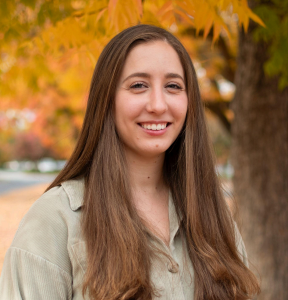
Jamie Mitchell - Post-Doctoral Researcher at Stanford University
Jamie is a recent graduate of the Stanford University Graduate School of Education’s Developmental and Psychological Sciences program. She received her B.A. in Education Sciences from the University of
California, Irvine, focusing on Children’s learning and Development and along with a minor in Psychology and Social Behavior. Her current research interests focus on understanding the relationship between behavioral measures of reading ability and neural mechanisms of reading. She is particularly interested in uncovering neural profiles of dyslexia and how these profiles relate to different behavioral profiles of dyslexia. Jamie is also interested in understanding the neural mechanisms that underly the processing of visual forms of language (i.e. text and signed languages) in Deaf and Hard-of-Hearing individuals. She is continuing her research as a postdoctoral researcher in the Brain Development and Education Lab at Stanford University.
Connect with Jamie on LinkedIn: https://www.linkedin.com/in/profile/
View Jamie's work on ORCiD and Google Scholar
Visit Jamie's Personal Website: https://jamielmitchell.github.io/jamielmitchell/
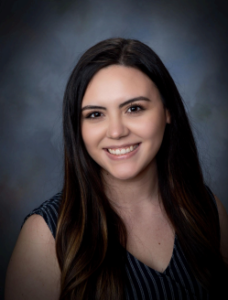 Mia Jimenez - PhD student Stanford University; Developmental and Behavioral Sciences Program
Mia Jimenez is a PhD student in the Developmental and Psychological Sciences program at the Stanford Graduate School of Education. Her research background sits at the intersection of psychology, education, criminology, and neuroscience, with a focus on how children's environments shape learning, developmental trajectories, and brain development. She is especially interested in protective factors that support academic resilience among students from underrepresented backgrounds. As a first generation college graduate and QuestBridge Scholar, Mia is passionate about using research to challenge deficit based narratives about adversity and to better understand the strengths, adaptations, and protective factors that help students thrive.