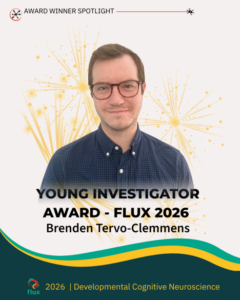
 The Flux Society is pleased to recognize Brenden Tervo-Clemmens as the recipient of the Flux Society 2026 Young Investigator Award.
Dr. Tervo-Clemmens is an assistant professor at the University of Minnesota in the Masonic Institute for the Developing Brain and Department of Psychiatry & Behavioral Sciences. His research focuses on adolescent brain development and mental health, with work that integrates developmental cognitive neuroscience, developmental psychopathology, quantitative methods, and psychometrics and is grounded in his previous experience in the clinical field.
Across his research, Dr. Tervo-Clemmens examines the neurodevelopment of executive function, impulsivity, and risk taking while also advancing methods that can strengthen the reproducibility, clinical relevance, and policy utility of the work in the developmental cognitive neuroscience space.
The Young Investigator Award recognizes outstanding contributions by scientists early in their careers. In this spotlight, Dr. Tervo-Clemmens reflects on the experiences that inform his passion, the Flux community’s role in his development as a researcher, the meaning of this recognition, and the future directions he is most excited about in the field.
From Clinical Practice to Developmental Cognitive Neuroscience
For Dr. Tervo-Clemmens, the path into research began with direct, on the ground, clinical experience. Before starting his career as a researcher, he worked closely with adolescents navigating psychiatric and neurodevelopmental challenges. These experiences shaped the questions that he would later pursue in his journey as a clinician-scientist.
When asked “What inspired you to pursue this area of research?” Dr. Tervo Clemmens says:
“Before I was a researcher, I worked as a behavioral specialist in a residential treatment program for teens with psychiatric and neurodevelopmental disorders. That experience really shaped how I would end up thinking about research and my ultimate career as a clinician-scientist. Seeing just how complicated and interconnected cognitive, emotional, and social challenges are made me want to understand the mechanisms of adolescent mental health. After a chance opportunity to help with research, and several twists and turns along the way, I found my way into developmental cognitive neuroscience research. The motivation to understand the mechanisms underlying adolescent mental health and eventually make our research clinically relevant continues to drive my work.”
A Scientific Home in the Flux Community
A central theme in Dr. Tervo-Clemmens’ reflections are community and collaboration. He describes Flux not only as a conference, but as a scientific home, a space that helped to shape his thinking, build some of his collaborations, and inform his approach to interdisciplinary developmental science. As a researcher who blends so many different fields and works across various disciplines, the work that Dr. Tervo-Clemmens brings to Flux touches so much of what is at the heart of the developmental cognitive neuroscience focus.
In thinking about how the Flux and broader development cognitive neuroscience community has shaped his work so far, Dr. Tervo-Clemmens says:
“Flux is my home conference, and this community really helped ‘raise’ me in science. I have been to all but two of the Flux meetings. My own research aims to integrate multiple areas—developmental cognitive neuroscience, developmental psychopathology, quantitative methods/psychometrics—and so much of my thinking on how to do this work, address big questions, and collaborate has been inspired by the Flux and developmental cognitive neuroscience community. I think this intersection across different areas is our field’s greatest strength, and I try to embody that as much as possible.”
Full-Circle Recognition
Receiving this award from Flux carries special meaning for Dr. Tervo-Clemmens. The Flux community is incredibly excited to recognize the work that Dr. Tervo-Clemmens has done and will continue to do. As a graduate student, he followed the work of past awardees and imagined the kind of impact he hoped his own science might have one day.
Dr. Tervo-Clemmens says that his younger self would be over the moon. Here’s what he says about what his younger self would think of receiving this award:
“My younger self, much like my current self, would have been over the moon to receive this award! As a graduate student, I used to totally nerd out on the science of previous winners of this award and hoped that my own work would one day have that kind of impact. It is an incredible honor to join the outstanding scientists who received this award before me. Being recognized by my ‘home conference’ also feels particularly special.”
The People Behind the Work
Dr. Tervo-Clemmens also emphasized that scientific careers are shaped and supported in many different ways, from mentors who guide the work, collaborators who work alongside, mentees that learn and also teach, and staff that makes all the work possible. His acknowledgements reflect the many people who have contributed to his trajectory and continue to shape the work moving forward.
When asked if there was someone he would like to acknowledge that supported his work, Dr. Tervo-Clemmens says:
“So many people have helped me along the way! I would particularly like to acknowledge my graduate mentor Bea Luna at the University of Pittsburgh and postdoc mentors Eden Evins, Jodi Gilman, and Randi Schuster at MGH/Harvard. I am also deeply grateful to the collaborators and friends who have supported my trajectory and make doing this work so fun. To name just a few: Scott Marek, Damien Fair, Nico Dosenbach, Finn Calabro, Bart Larsen, Ashley Parr, Deanna Barch, Maria Jalbrzikowski, and David Montez. Finally, I want to thank my mentees and staff, who are carrying this work forward while also teaching me exciting new ways to think about our field.”
Looking Ahead
When looking toward the future of the field and of the developmental cognitive neuroscience work, Dr. Tervo-Clemmens points to the incredible strengths that we are working within today and toward the promise of precision neuroimaging and individualized brain-behavior associations. For him, these approaches offer opportunities to deepen understanding of normative development, strengthen translation of the work, and sharpen the field’s methodological toolkit.
When thinking about the kinds of changes he would like to see in the field in the next few years, Dr. Tervo-Clemmens says:
“I think our field is in a very strong place right now. We continue to benefit from large developmental consortia and have seen recent, rapid advancements in smaller dense-sampling and precision neuroimaging studies. I am particularly interested in efforts to advance precision neuroimaging in our field, and specifically in linking individualized brain function to behavioral development. I think tailoring developmental cognitive neuroscience toward individual brain-behavior associations can improve our understanding of normative development, increase the potential for clinical translation, and help sharpen our methodological toolkit.”
Congratulations
Please join us in congratulating Brenden Tervo-Clemmens, recipient of the Flux Society 2026 Young Investigator Award. We are excited to celebrate his contributions to developmental cognitive neuroscience and so much of our work as well as look forward to his continued impact on the field and within our community.
Read more about the Flux Society award winners on our LinkedIn page.
Learn more about the Flux 2026 Conference.
About the Author
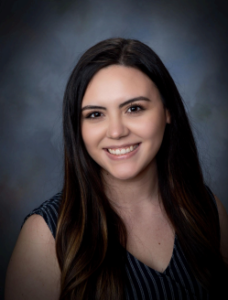
Mia Jimenez - PhD student Stanford University; Developmental and Behavioral Sciences Program
Mia Jimenez is a PhD student in the Developmental and Psychological Sciences program at the Stanford Graduate School of Education. Her research background sits at the intersection of psychology, education, criminology, and neuroscience, with a focus on how children's environments shape learning, developmental trajectories, and brain development. She is especially interested in protective factors that support academic resilience among students from underrepresented backgrounds. As a first generation college graduate and QuestBridge Scholar, Mia is passionate about using research to challenge deficit based narratives about adversity and to better understand the strengths, adaptations, and protective factors that help students thrive.