The Flux Trainee Committee is excited to spotlight the exciting research of promising trainees. Each blog post will feature a brief interview with our 2026 FLUX travel award recipients. In this post, we caught up with Beatrice Ojuri to discuss her work recently presented at FLUX.
Beatrice (Bea) Oju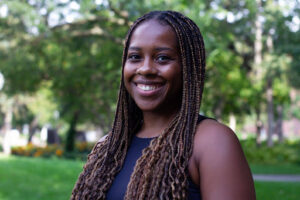 ri (She/Her)
PhD Student | The Cognition and Neurodevelopmental Studies Lab
University of Minnesota
Center for Developmental NeuroImaging
Fun fact: I love traveling. My goal for this year was to take a trip every month, and so far I’m on track!
What is the focus of your research?
My research focuses on understanding heterogeneity and mechanisms underlying neurodevelopmental conditions, specifically ADHD and autism, across multiple levels of analysis.
What is your main research interest(s)?
My research focuses on understanding heterogeneity and mechanisms underlying neurodevelopmental conditions, specifically ADHD and autism, across multiple levels of analysis. I am particularly interested in identifying shared and distinct features across these conditions and understanding how they relate to brain organization, behavior, and real-world functioning. My current projects approach these questions from complementary perspectives.
For one project, I examined ADHD-related traits in children with a family history of autism, providing insight into potential shared developmental pathways underlying ADHD and autism. This project found that ADHD-related traits were elevated in children with a family history of autism, even among children without autism. It also examined the overlap between ADHD and autism, showing that their co-occurrence is associated with greater trait severity and poorer functioning. This work reflects my broader interest in understanding the factors that may contribute to the overlap seen in neurodevelopmental conditions.
In another project, I am studying the Somato-cognitive Action Network (SCAN), a brain network involved in integrating information related to the body, movement, and cognition. I am examining whether variation in SCAN organization is associated with ADHD and broader neurodevelopmental traits, and whether these neural differences relate to real-world functioning, particularly cognitive and motor control.
Together, these projects allow me to investigate neurodevelopmental heterogeneity across multiple levels of analysis, with the broader goal of understanding mechanisms that cut across diagnostic boundaries and identifying shared and distinct features of neurodevelopmental conditions.
What has been the most meaningful or formative experience in your training so far?
The most meaningful experience in my training has been conducting clinical assessment work with children and their families. Working directly with individuals with neurodevelopmental conditions has deepened my understanding of the substantial heterogeneity that exists within a single diagnosis and the ways that strengths and challenges can present differently across individuals. This experience has also
highlighted the importance of integrating information across multiple levels, including developmental history, behavioral observations, cognitive performance, and standardized measures, to understand an individual’s unique profile. Seeing how these different sources of information complement one another has strengthened my interest in studying neurodevelopmental conditions using a multi-level approach. It has also reinforced my motivation to conduct research that moves beyond diagnostic categories to better understand individual differences and ultimately improve how we characterize and support diverse experiences.
What do you see as the broader impact of your work?
The broader goal of my work is to improve our understanding of why neurodevelopmental conditions vary so widely across individuals and why they frequently co-occur. By examining shared and distinct features across ADHD and autism, my research integrates both diagnostic and dimensional approaches to better capture variation that traditional diagnostic categories may miss. Importantly, I approach these questions across multiple levels of analysis. Integrating varying but complementary levels may reveal relationships
and mechanisms that cannot be fully understood by examining any single level in isolation. Ultimately, I hope this work contributes to a more comprehensive understanding of neurodevelopmental conditions and supports more nuanced approaches to assessment and intervention that better reflect the diversity of individual experiences.
How have mentorship, collaboration, or community shaped your development as a scientist?
Mentorship and collaboration have shaped my development as a scientist by exposing me to perspectives that differ from my own, reflecting our varied backgrounds and training. Learning from and collaborating with people without a clinical background who approach similar questions from different perspectives has strengthened my ability to think across multiple levels of analysis and, in turn, shaped the scientist I hope to become. Equally important, engaging with the communities and individuals represented in my research has reinforced that my motivation should extend beyond advancing scientific knowledge. Learning about the experiences and needs of the populations I study has encouraged me to consider how my research can better serve them as well as strengthened my commitment to conducting science that is both rigorous and meaningful to the people it is intended to benefit.