
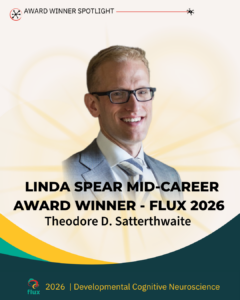
The Flux Society is pleased to recognize Theodore D. Satterthwaite as the recipient of the Flux Society 2026 Linda Spear Mid-Career Award.
Dr. Satterthwaite is the McLure II Professor at the University of Pennsylvania Perelman School of Medicine and Director of PennLINC. His research uses large scale, multimodal neuroimaging to understand both typical and atypical patterns of brain development with the broader goal of advancing knowledge about the origins of neuropsychiatric illness. His work has also helped move the field toward more scalable, reproducible, and clinically relevant neuroscience. The Linda Spear Mid-Career Award recognizes outstanding contributions by scientists at the mid-career stage whose work has advanced developmental cognitive neuroscience. In this spotlight, Dr. Satterthwaite reflects on the questions, clinical in nature, that shaped his path into research, the Philadelphia Neurodevelopmental Cohort as a turning point, the trainees who have made science “super fun,” and his hopes for the next phase of the field.
From Clinical Practice to Developmental Neuroimaging
For Dr. Satterthwaite, the path into developmental cognitive neuroscience began with a clinical problem - psychiatry lacks the kinds of imaging tools as well as the fundamental frameworks that can routinely inform diagnosis, prognosis, and treatment selection. That question first brought him into imaging research, and later, the launch of the Philadelphia Neurodevelopmental Cohort helped shift his lab’s focus toward brain development. When asked what inspired him to pursue this area of research, Dr. Satterthwaite says: “I started doing imaging research because psychiatry—almost uniquely in medicine—lacks imaging that can inform diagnosis, prognosis, or treatment selection. I initially worked on small, prospective samples of adults I recruited from my clinical practice. However, I was lucky enough to be a post-doc at Penn with Raquel Gur when the Philadelphia Neurodevelopmental Cohort was launched. As it happens, at around the same time, my twins were born – which really put development front-and-center in my day-to-day life. The PNC was an incredible opportunity and real turning point; my lab has focused on brain development ever since. The size and complexity of the data from the PNC also led us to grapple with the many challenges of massive imaging studies. Over time, this also led us focus on neuroinformatics for scalable and reproducible neuroscience.”
The Meaning of the Award
Receiving a mid-career award can be a moment to reflect on the distance between where a scientist began and where their work has led. For Dr. Satterthwaite, the idea of receiving this recognition would have come as a surprise to his younger self. When asked “What would your younger self think about receiving this award?” Dr. Satterthwaite says: “Extremely surprised, to say the least.”
The People Behind the Science
Dr. Satterthwaite’s reflections also center the people who have shaped the work. Rather than framing scientific ideas as coming from one person or one source, he points to the trainees as the source of many of the lab’s best ideas and as a major reason the work has been meaningful. When asked if there was someone he would like to acknowledge that supported the work, Dr. Satterthwaite says: “Looking back, one thing that really stands out is that the best ideas in the lab have not come from me – they come from the trainees. I have just been incredibly lucky to be able to work with a truly outstanding collection of brilliant humans who make science super fun.”
Looking Ahead: Reproducibility and Translation
When looking toward the future of developmental cognitive neuroscience, Dr. Satterthwaite points to the field’s growing emphasis on reproducibility, replication, and generalizability. He also highlights the importance of translating observational findings into clinical trials that can eventually inform patient care. When asked what kind of change he’d like to see in the field in the next few years, Dr. Satterthwaite says: “I think our field has undergone tremendous growth over the past several years, including a major new focus on reproducibility, replication, and generalizability. In the next period, I would be beyond delighted if the results from observational studies motivated well-designed clinical trials of precision diagnostics and personalized therapeutics. Clinical trials are challenging and expensive but ultimately are essential for any translation to patient care.”
Congratulations
Please join us in congratulating Theodore D. Satterthwaite, recipient of the Flux Society 2026 Linda Spear Mid-Career Award. We are excited to celebrate his contributions to developmental cognitive neuroscience, neuroimaging, neuroinformatics, and reproducible science. Read more about the Flux Society award winners on our LinkedIn. Learn more about the Flux 2026 Conference.
About the Authors
 Howard Chiu - PhD student, Stanford University; Developmental and Psychological Sciences Program
Howard Chiu is a PhD student in the Graduate School of Education’s Developmental and Psychological Sciences program at Stanford University. He received his B.A. in Experimental Psychology from the University of Oxford and M.Ed. in Educational Psychology from the Melbourne Graduate School of Education. Prior to coming to Stanford, Howard worked in Singapore as an educational psychologist in the Ministry of Education’s Special Educational Needs Division. His research will focus on using transdiagnostic longitudinal neuroimaging methods to understand the developmental trajectories of individuals, so as to better understand how neural development relates to educational and other well-being outcomes. He is also interested in how environmental effects and interventions can alter these trajectories.
Visit Howard's personal webpage.
Connect with Howard on LinkedIn.
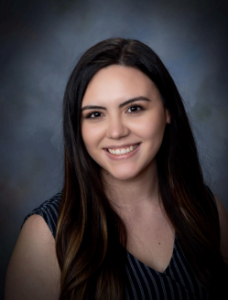 Mia Jimenez - PhD student Stanford University; Developmental and Behavioral Sciences Program
Mia Jimenez is a PhD student in the Developmental and Psychological Sciences program at the Stanford Graduate School of Education. Her research background sits at the intersection of psychology, education, criminology, and neuroscience, with a focus on how children's environments shape learning, developmental trajectories, and brain development. She is especially interested in protective factors that support academic resilience among students from underrepresented backgrounds. As a first generation college graduate and QuestBridge Scholar, Mia is passionate about using research to challenge deficit based narratives about adversity and to better understand the strengths, adaptations, and protective factors that help students thrive.